Gradual typing
LuaScript has a Luau-style gradual type system. Annotations are optional, they are checked at compile time, and they are erased before bytecode is generated. The VM never sees a type, so typed code runs exactly as fast as untyped code.
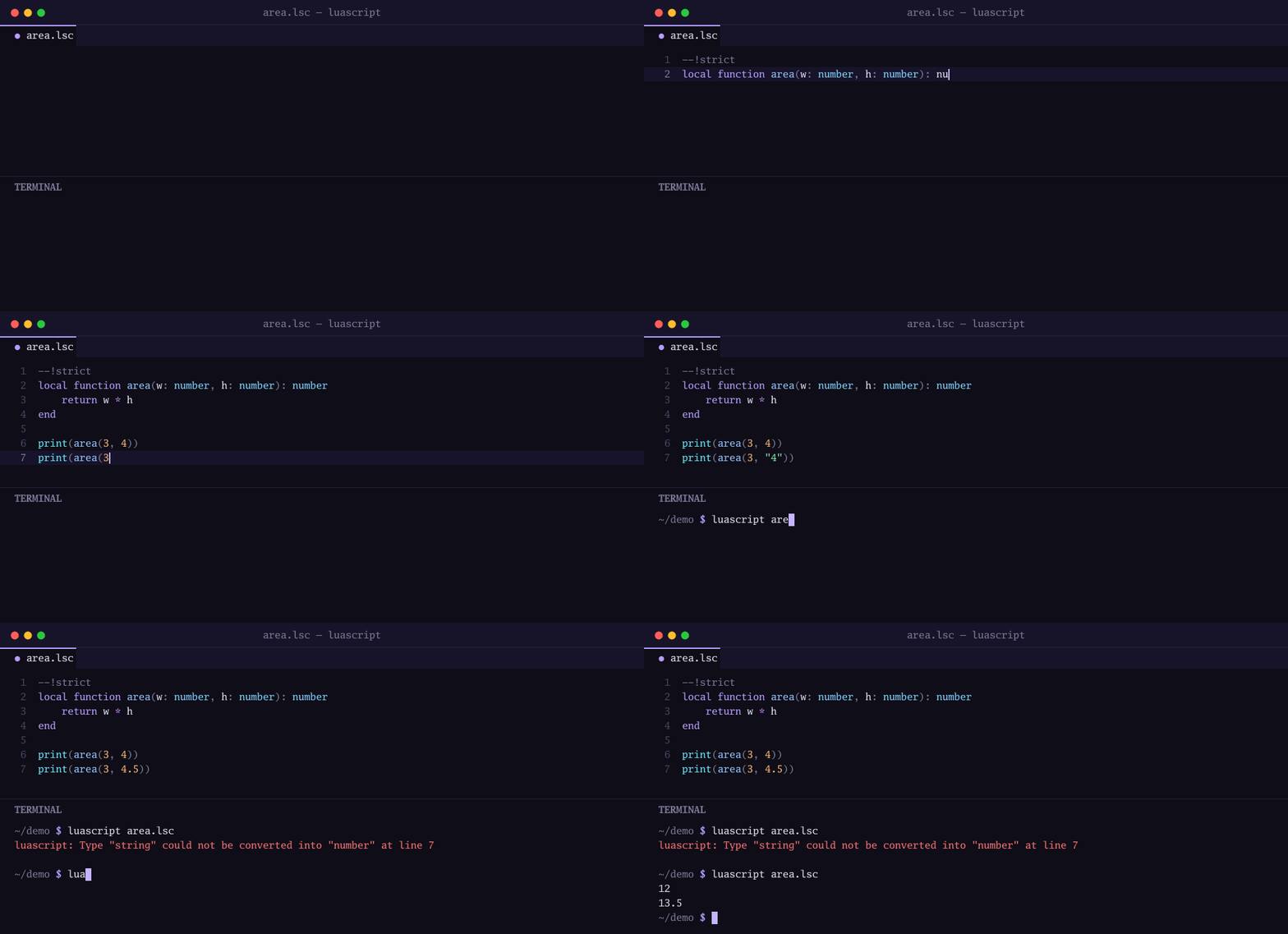
The model
- Optional. You can write plain Lua and never annotate anything. Precision arrives exactly where you write it down.
- Checked at compile time. The checker runs between the parser and the bytecode generator. A type error stops the file before a single instruction executes.
- Erased. Types carry no runtime cost and no runtime meaning. A type assertion emits no code.
- Untyped means
any. An unannotated parameter isany, which flows into and out of every typed slot. This is what keeps existing Lua code working unchanged.
local function untyped(x) return x * 2 end   -- x is any, the result is any
local doubled: number = untyped(21)          -- any flows into number
print(doubled)                               -- 42
How much the checker requires is set per file with a mode directive (--!strict, --!nonstrict, --!nocheck). See Strict mode.
Annotations
Annotate a local, a parameter or a return type with : Type. Multiple return values are a parenthesised list.
local count: number = 42
local name: string = "Ada"

local function add(a: number, b: number): number
    return a + b
end

local function divmod(a: number, b: number): (number, number)
    return a // b, a % b
end

local q, r = divmod(17, 5)
print(add(2, 3), q, r)   -- 5	3	2
A vararg can be annotated too: function sum(...: number): number.
Unannotated locals are inferred from their initialiser, and the inferred type sticks:
local x = 5
x = "five"
luascript: Type "string" could not be converted into "number" at line 2Two exceptions keep dynamic Lua working: a local initialised with nil, and an unannotated table literal, are both any. A table literal that meets an annotation is checked against it; see Checking table literals.
Primitives
| Type | Meaning |
|---|---|
number | Integers and floats alike. There is no separate integer type. |
string | Strings. |
boolean | true / false. |
nil | The nil value. |
any | The gradual escape hatch: flows both in and out of anything. |
unknown | The safe top type: anything flows in, nothing flows out until you narrow or assert. |
never | The empty type. No value inhabits it. |
local opaque: unknown = "payload"
local s: string = opaque
luascript: Type "unknown" could not be converted into "string" at line 2Table types
Three shapes cover tables:
type Point = { x: number, y: number }   -- record: named fields
type Numbers = { number }               -- array: shorthand for { [number]: number }
type Ages = { [string]: number }        -- map: an explicit indexer

local origin: Point = { x = 0, y = 0 }
local primes: Numbers = { 2, 3, 5, 7 }
local ages: Ages = { ada = 36 }
print(origin.x, primes[3], ages.ada)    -- 0	5	36
Field access through a typed record is checked:
local p: { x: number, y: number } = { x = 1, y = 2 }
print(p.z)
luascript: type "{ x: number, y: number }" has no field "z" at line 2Checking table literals
On its own a table literal is any. When it meets a known type, the checker checks the literal against that type. This happens with a local or field annotation, a typed parameter at a call site, a declared return type, or a default parameter value. Record fields are checked against their field types. Array elements are checked against the element type, and map entries against the key and value types. Nested literals are checked recursively.
type User = { name: string, age: number, nick: string? }
type Point = { x: number, y: number }

local u: User = { name = "Ada", age = "36" }
local p: Point = { x = 1 }
local q: Point = { x = 1, y = 2, z = 3 }
local xs: { number } = { 1, "two" }
luascript: Type "string" could not be converted into "number" in field "age" at line 4
table literal is missing required field "y" of type "number" at line 5
table literal has field "z", which type "Point" does not declare at line 6
Type "string" could not be converted into "number" in field "[2]" at line 7The same checks apply to arguments and return values:
type Point = { x: number, y: number }
local function len(p: Point): number return p.x + p.y end
print(len({ x = 1, y = "2" }))
local function origin(): Point
  return { x = 0 }
end
luascript: Type "string" could not be converted into "number" in field "y" at line 3
table literal is missing required field "y" of type "number" at line 5The rules:
- Optional fields (
nick: string?) may be left out. Every other declared field must be present. - Extra fields are rejected when the literal is checked against a record, which catches misspelled optional fields. A variable that already holds a wider table still passes, because table types are structural.
anystays unchecked. A target ofany,unknownor a generic type parameter is not checked, and neither is a value whose type isany.- An empty
{}is accepted for any record, so you can still build a table field by field:local p: Point = {}thenp.x = 1. - Spread (
{ ...base, x = 3 }) turns off the missing-field check, because the spread may supply those fields. - Unions pick the member the literal fits, so
{ kind = "circle", r = 1 }checks against the right arm of a discriminated union. - Struct types check only the declared fields. Members added with
impllive on the class table, so a literal does not need to provide them.
Optionals and unions
T? is sugar for T | nil. A union A | B accepts a value of either type.
local maybe: string? = nil
local id: number | string = "user-7"

-- `x or default` drops nil from the result type:
local resolved: string = maybe or "anonymous"
print(resolved, id)   -- anonymous	user-7
Literal types
A string, number or boolean literal is a type of its own, inhabited by exactly one value. A union of literals is a closed set, the closest thing to a string enum:
type Mode = "read" | "write" | "append"

local function open(m: Mode)
    print("opening for", m)
end

open("read")
open("nope")

local s: string = "read"
local m: Mode = s
luascript: Type '"nope"' could not be converted into "Mode" at line 8
Type "string" could not be converted into "Mode" at line 11A literal is assignable to its base primitive, never the reverse. Inference widens: local m = "read" is a string, not "read", so you can reassign it. Annotate to keep the singleton. Number and boolean literals work the same way (type Bit = 0 | 1).
Function types
A function type is written (Params) -> Return. Use () for "returns nothing" and a parenthesised list for multiple returns.
type Callback = (number) -> string

local render: Callback = function(n: number): string
    return "<" .. n .. ">"
end

local log: (string) -> () = function(s: string) print(s) end
local swap: (number, number) -> (number, number) = function(a: number, b: number): (number, number)
    return b, a
end

log(render(9))     -- <9>
print(swap(1, 2))  -- 2	1
Calls are checked for argument types and arity:
local function add(a: number, b: number): number
    return a + b
end
add(1, "2")
add(1)
luascript: Type "string" could not be converted into "number" at line 4
call passes 1 args, function expects at least 2 at line 5Type aliases
type Name = T names any type: a primitive, a union, a record, a function type. Aliases can be generic (type Box<T> = { value: T }), and interface Name { ... } is an alias whose target is a table shape.
Aliases are local to the file that declares them. There is no export type, and a recursive alias (type Tree = { children: { Tree } }) is rejected with unknown type "Tree".
Type assertions
expr :: T tells the checker to believe you. It is a compile-time cast: it emits no code and checks nothing at run time.
local opaque: unknown = "some payload"
local revealed: string = opaque :: string
print(revealed)

local lie: any = "not a number"
local n = lie :: number
print(type(n))   -- string: the assertion did not convert anything
Narrowing
The checker tracks what a branch proves about a local and narrows its type inside that branch. Narrowings never escape the branch that established them, and assigning to the local widens it back to its declared type.
-- nil guard
local function len(s: string?): number
    if s == nil then
        return 0
    end
    return #s           -- s is a string here
end

-- truthiness and `not`
local function first_char(s: string?): string
    if not s then
        return ""
    end
    return s:sub(1, 1)
end

-- type guards, with elseif negation
local function fmt(v: number | string | boolean): string
    if type(v) == "number" then
        return string.format("%.1f", v)
    elseif type(v) == "string" then
        return v
    end
    return tostring(v)  -- only boolean is left
end

-- assert() narrows the rest of the block
local function shout(s: string?): string
    assert(s, "need a string")
    return s:upper()
end

-- short-circuit: the right-hand side sees the left-hand side's proof
local function non_empty(s: string?): boolean
    return s ~= nil and #s > 0
end

print(len(nil), first_char("xyz"), fmt(2), fmt(true), shout("hi"), non_empty("a"))
Without the guard, the same code is rejected:
local function len(s: string?): number
    return #s
end
luascript: the # operator expects a string or table, got "string | nil" at line 2The full set of refinements:
| Form | Effect |
|---|---|
x == nil / x ~= nil | Removes or keeps nil. |
if x then / if not x then | Truthiness removes nil. (false is not split out of boolean.) |
type(x) == "number" | Narrows a union to the named primitive; sees through literal types. |
x == "read" | Narrows a literal union to that member. |
and / or / not | Propagate through compound conditions. |
elseif | Accumulates the negations of earlier clauses. |
assert(cond) | Narrows for the rest of the block. |
| Early exit | A leading if that always returns, breaks, continues, throws or calls error() narrows everything after its end. goto does not count. |
x or default | Drops nil (and a literal false) from the result, so cond and 0.1 or -0.1 is a number. |
Only simple identifiers narrow. Field paths such as t.name are not tracked, so if t.name ~= nil then return #t.name end is still an error. Copy the field into a local first: local name = t.name.
Standard library signatures
The globals and auto-loaded libraries (math, string, table, os, io, utf8, ...) have hand-written signatures, so misuse is a compile error rather than a runtime surprise:
print(math.sqrt(true))
print(string.rep("ab", "3"))
local n: string = math.floor(3.7)
luascript: Type "boolean" could not be converted into "number" at line 1
Type "string" could not be converted into "number" at line 2
Type "number" could not be converted into "string" at line 3Native modules are typed too. When require is called with a literal module name, the result has that module's declared type:
local json = require("json")
local text: string = json.encode({ a = 1 })   -- fine
local bad: number = json.encode({ a = 1 })
luascript: Type "string" could not be converted into "number" at line 3Requiring one of your own .lsc files returns any; there is no cross-module type checking. If you shadow require with your own function (local require = ..., or by assigning the global), its results are any too. See Native modules for the module list.
Runtime reflection: typeof
Because types are erased, there is no type-level typeof operator. typeof(v) is a runtime function: like type, but it distinguishes integer from float and honours a metatable's __type field, which is how structs and tagged enums report their names.
print(type(10), typeof(10), typeof(2.5)) -- number integer floatWhat is deliberately out
- Cross-module type checking. A
require()of a script module isany; only native modules carry types. - Recursive aliases. The parser accepts them; the resolver does not.
- Exported types. Aliases do not cross file boundaries.
- Explicit type arguments at a call site (
id<number>(5)); type arguments are always inferred. See Generics.
Intersections (A & B) and literal types, listed as out in earlier designs, are now supported. See Generics & interfaces and Literal types.
The runnable tour is examples/05_types.lsc.