Pattern matching
match tests one value against a list of patterns, top to bottom, and runs the first arm that fits. Patterns can compare values, test runtime types, destructure tagged enums and structs, and carry if guards. When the subject has a finite domain, the checker proves that every case is handled.
Syntax
local function classify(n)
    match n do
        0       -> print("zero")
        1, 2, 3 -> print("small")
        _       -> print("other")
    end
end

classify(0)    -- zero
classify(2)    -- small
classify(42)   -- other
match <expr> do ... end. The subject is evaluated exactly once, even if it has side effects.- Each arm is
pattern -> statement. The body is a single statement; wrap several indo ... end. - Arms are tried in order and the first match wins. There is no fall-through between arms.
- If no arm matches, the statement does nothing and control continues after
end.
local x = 2
match x do
    1 -> print("one")
    2 -> do
        print("two")
        print("(and a second line)")
    end
    _ -> print("?")
end
match is a statement, not an expression. local label = match n do ... end is a parse error. Assign inside the arms, or return from them in a helper function.
Patterns
| Pattern | Matches when |
|---|---|
0, "hi", true, nil | The subject == the literal. |
1, 2, 3 | Any of the comma-joined alternatives matches. |
_ | Always. The catch-all. |
n: number | type(subject) == "number"; binds it as n. |
p: Point | typeof(subject) == "Point" (structs and enums); binds it. |
_: string | Type test without binding. |
x: any | Always; binds the subject. |
Shape.Circle(r) | The subject is that variant; binds the payload positionally. |
Point{ x = px } | The subject is a Point; binds the named fields. |
Color.RED, double(4) | Any other expression is a value pattern, compared with ==. |
Any arm can add a guard: pattern if cond -> body.
Values and typed bindings
struct Point { x: number, y: number }

local function describe(v): string
    match v do
        nil        -> return "nothing"
        0          -> return "zero"
        n: number  -> return "number " .. n
        s: string  -> return "string of length " .. #s
        p: Point   -> return "point at " .. p.x .. "," .. p.y
        _: boolean -> return "a boolean"
        _          -> return "something else: " .. typeof(v)
    end
    return "unreachable"
end

print(describe(nil))           -- nothing
print(describe(0))             -- zero
print(describe(7))             -- number 7
print(describe("hey"))         -- string of length 3
print(describe(Point(1, 2)))   -- point at 1,2
print(describe(false))         -- a boolean
print(describe({}))            -- something else: table
Primitive type names probe type(); struct and enum names probe typeof(). Inside the arm the binder has the named type, so #s and p.x are checked.
A string literal right after a call chains as a call in Lua (f"x" is f("x")). When one arm's body ends in a call and the next pattern starts with a string, end the arm with ;:
local function greet(s)
    match s do
        "hi", "hello" -> print("greeting");
        "bye"         -> print("farewell");
        _             -> print("?")
    end
end
greet("hello")   -- greeting
Guards
pattern if cond -> body matches only when the pattern fits and the guard is true. If the guard fails, matching continues with the next arm, so overlapping patterns can be split by guard:
local function sign(n: number): string
    match n do
        x: number if x > 0 -> return "positive"
        x: number if x < 0 -> return "negative"
        _                  -> return "zero"
    end
    return "?"
end

print(sign(7), sign(-3), sign(0))   -- positive	negative	zero
Destructuring tagged enums
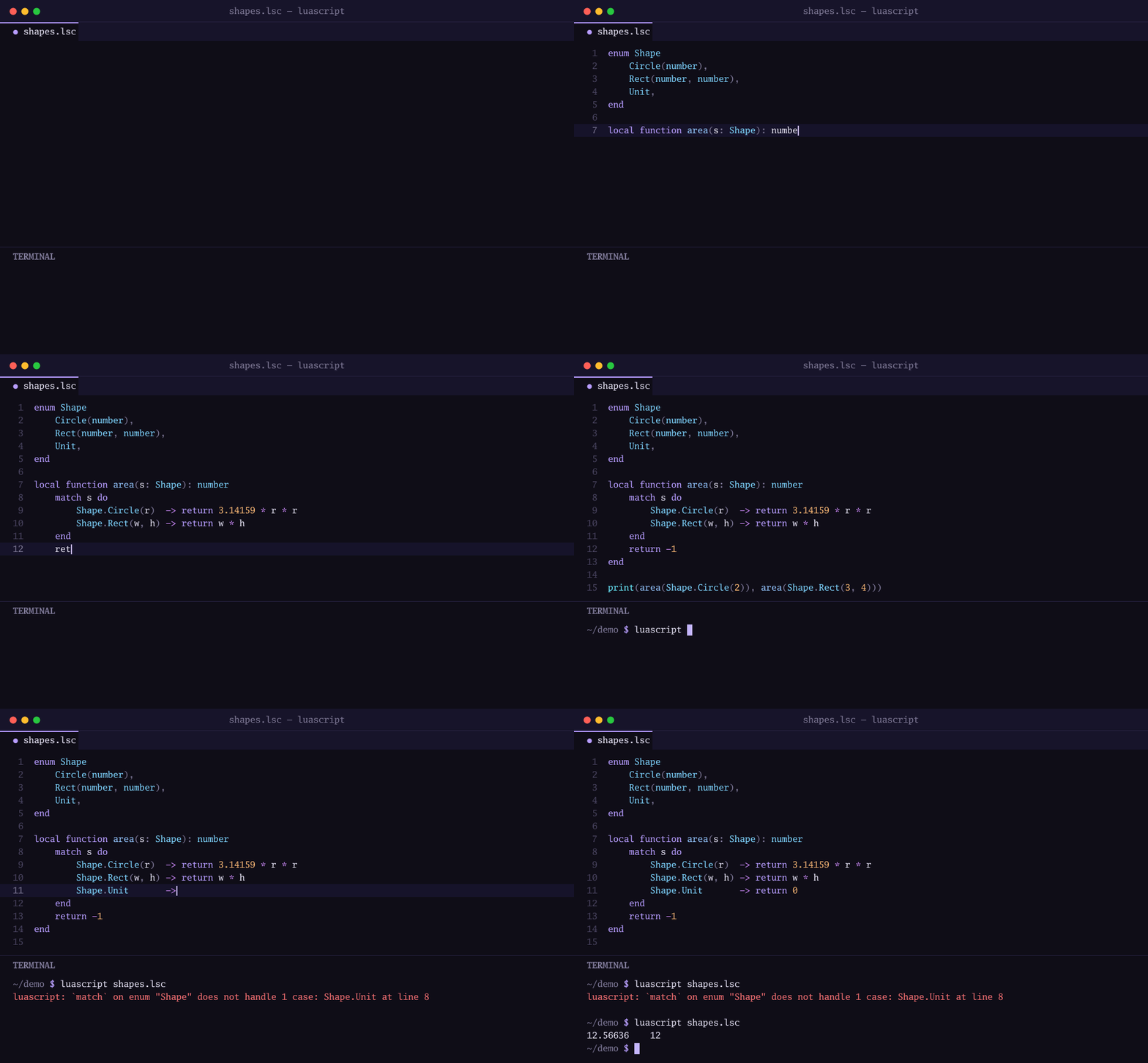
Enum.Variant(a, b) matches on the variant tag and binds the payload positionally. Use _ to skip a position. A nullary variant is matched by name alone.
enum Shape
    Circle(number),
    Rect(number, number),
    Unit,
end

local function area(s: Shape): number
    match s do
        Shape.Circle(r)  -> return 3.14159 * r * r
        Shape.Rect(w, h) -> return w * h
        Shape.Unit       -> return 0
    end
    return -1
end

local function height(s: Shape): number
    match s do
        Shape.Rect(_, h) -> return h
        _                -> return 0
    end
    return -1
end

print(area(Shape.Circle(5)))       -- 78.53975
print(area(Shape.Rect(3, 4)))      -- 12
print(height(Shape.Rect(3, 4)))    -- 4
Destructuring structs
Struct{ field = binder } matches by nominal type and binds the fields you name. Unnamed fields are ignored.
struct Point { x: number, y: number }

local function quadrant(p): string
    match p do
        Point{ x = px, y = py } if px >= 0 and py >= 0 -> return "Q1"
        Point{ x = px, y = py } if px < 0 and py >= 0  -> return "Q2"
        Point{ x = px }                                -> return "lower half (x=" .. px .. ")"
        _                                              -> return "not a Point"
    end
    return "?"
end

print(quadrant(Point(1, 2)))    -- Q1
print(quadrant(Point(-1, 2)))   -- Q2
print(quadrant(Point(1, -2)))   -- lower half (x=1)
print(quadrant(42))             -- not a Point
When a call-shaped pattern is just a value
Destructuring is gated on names declared in the same file: Circle(r) reads a tag only because Circle is a payload variant declared here, and Point{ x = a } only because Point is a struct declared here. Any other call-shaped pattern is an ordinary value pattern, compared with ==:
local function double(n) return n * 2 end

match 8 do
    double(4) -> print("8 == double(4), compared by value")
    _         -> print("no match")
end
Variants and structs imported from another module are therefore matched by value too. Use a guard on __tag for those, e.g. v: any if v.__tag == "Ok" -> ....
Exhaustiveness
When the subject's type has a finite domain, the checker requires the arms to cover all of it. A missing case is a compile error:
enum Shape
    Circle(number),
    Rect(number, number),
    Unit,
end

local function area(s: Shape): number
    match s do
        Shape.Circle(r)  -> return 3.14159 * r * r
        Shape.Rect(w, h) -> return w * h
    end
    return -1
end
luascript: `match` on enum "Shape" does not handle 1 case: Shape.Unit at line 8This matters because an unmatched match is a no-op at run time. In a function whose arms all return, a forgotten case would surface as a silent nil far from the real mistake.
A subject is enumerable in exactly three situations:
| Subject type | Domain |
|---|---|
| A tagged enum | Its variants: Shape.Circle, Shape.Rect, Shape.Unit. |
A literal union, including a bare enum | Its members: "read" | "write" | "append", or Color.RED, ... |
boolean | true and false. |
type Mode = "read" | "write" | "append"
local function verb(m: Mode): string
    match m do
        "read" -> return "reading"
    end
    return "?"
end

local function yesno(b: boolean): string
    match b do
        true -> return "yes"
    end
    return "?"
end

enum Color RED, GREEN, BLUE end
local function hex(c: Color): string
    match c do
        Color.RED -> return "#f00"
    end
    return "?"
end
luascript: `match` on type "Mode" does not handle 2 cases: "write", "append" at line 3
`match` on a boolean does not handle 1 case: false at line 10
`match` on enum "Color" does not handle 2 cases: Color.GREEN, Color.BLUE at line 18Anything else (any, string, number, an unannotated local) has no finite domain, so nothing is reported and plain Lua is unaffected.
Rules of coverage
- Comma-joined alternatives cover every value they list:
"write", "append" -> .... - A
_arm covers everything. It is the explicit way to opt out. - A typed arm the subject flows into also covers everything, such as
n: numberover a bare enum. - A guarded arm never counts as covering its case, because the guard can fail:
type Mode = "read" | "write"
local function f(m: Mode): string
    match m do
        "read" if true -> return "r";
        "write"        -> return "w"
    end
    return "?"
end
luascript: `match` on type "Mode" does not handle 1 case: "read" at line 3A Result pipeline
Everything together: a tagged Result, a fallible function, and an exhaustive match with no _ arm.
enum Result
    Ok(number),
    Err(string),
end

local function checked_sqrt(n: number): Result
    if n < 0 then
        return Result.Err("cannot sqrt a negative")
    end
    return Result.Ok(math.sqrt(n))
end

-- No `_` arm: the checker confirms Ok and Err are the whole of Result.
local function render(r: Result): string
    match r do
        Result.Ok(v)    -> return "ok: " .. v
        Result.Err(msg) -> return "error: " .. msg
    end
    return "?"
end

for _, n in ipairs({ 16, -4, 2 }) do
    print(string.format("sqrt(%d) -> %s", n, render(checked_sqrt(n))))
end
sqrt(16) -> ok: 4.0
sqrt(-4) -> error: cannot sqrt a negative
sqrt(2) -> ok: 1.4142135623731Add a third variant to Result and every non-exhaustive match over it becomes a compile error that points at the line to fix.
How it compiles
match is a real statement in the AST, not a parse-time desugar. The type checker binds and narrows arm binders and runs the exhaustiveness check; the bytecode generator lowers each arm to one test-and-branch, so the arms compile to a plain jump chain.
The runnable tours are examples/14_match.lsc and examples/44_match.lsc.