Errors, try & defer
LuaScript keeps Lua 5.4's error model (error, assert, pcall, xpcall) and adds three structured tools on top of it: try/catch/throw for handling, defer for cleanup, and the Lua 5.4 <close> attribute for scoped resources. All of them share one unwinding mechanism, so they compose: a defer runs when a try catches, a <close> variable is closed when a pcall traps, and an error thrown with throw can be caught by pcall.
Raising errors
error(value [, level]) raises an error. When the value is a string, a file:line: prefix is added. level picks which call to blame: 1 (the default) is the function that called error, 2 is its caller, and 0 adds no position at all.
local function parsePort(s)
    local n = tonumber(s)
    if n == nil then
        error("not a number: " .. s)
    end
    return n
end

print(pcall(parsePort, "8080"))   --> true	8080
print(pcall(parsePort, "http"))   --> false	raise.lsc:4: not a number: http

print(pcall(error, "no position", 0))   --> false	no position
Use level 2 in a validation helper, so the error points at the code that passed the bad argument:
local function check(n)
    if n < 0 then error("negative input", 2) end
    return n
end
local function run()
    return check(-1)      -- line 6 is blamed
end
local ok, err = pcall(run)
print(err)                --> level.lsc:6: negative input
assert(v [, message]) raises when v is false or nil, and otherwise returns its arguments. That makes it a natural wrapper for functions that return nil, err on failure.
print(pcall(assert, false))                      --> false	assert.lsc:1: assertion failed!
print(pcall(assert, nil, "custom message"))      --> false	custom message
print(assert(42, "unused"))                      --> 42	unused
In typed code, assert(cond) also narrows types for the rest of the block. See Types.
Catching errors with pcall and xpcall
pcall(f, ...) calls f in protected mode. It returns true followed by f's results, or false and the error value. f can be any callable value, including a table with a __call metamethod.
xpcall(f, handler, ...) does the same, but passes the error value through handler first and returns what the handler returns:
local function handler(err)
    return "handled: " .. tostring(err)
end
print(xpcall(function() error("boom", 0) end, handler))      --> false	handled: boom
print(xpcall(function(a, b) return a + b end, handler, 2, 3)) --> true	5
LuaScript runs the xpcall message handler after the stack has unwound, where Lua runs it before. A handler that calls debug.traceback therefore sees its own stack, not the stack of the failed call. To keep the failing stack, capture the traceback inside the protected function instead (see debug.traceback).
Error values
An error value does not have to be a string. Any value can be raised, and tables make good structured errors:
local ok, err = pcall(function()
    error({ code = 404, msg = "not found" })
end)
print(ok, type(err), err.code, err.msg)   --> false	table	404	not found
Non-string values are passed through unchanged; no position is added. If the table has a __tostring metamethod, it is used wherever the error is rendered as text, including when it reaches the top level uncaught:
local E = { __tostring = function(e) return "E" .. e.code .. ": " .. e.msg end }
error(setmetatable({ code = 500, msg = "oops" }, E))
luascript: E500: oopstry / catch / throw
try marks a protected region. If anything inside raises, control jumps to the catch handler with the raised value bound to a name. If the body completes, the handler is skipped.
try
    -- body
catch err do     -- the binding is optional; the `do` is not
    -- handler
end
throw expr raises a value. It behaves like error(expr) except that it never adds a position: the value arrives exactly as thrown.
local function validate(age)
    if type(age) ~= "number" then
        throw "age must be a number, got " .. type(age)
    end
    if age < 0 then
        throw { field = "age", reason = "must not be negative" }
    end
    return age
end

for _, input in ipairs({ 30, -1, "forty" }) do
    try
        print("ok: " .. validate(input))
    catch err do
        if type(err) == "table" then
            print("invalid " .. err.field .. ": " .. err.reason)
        else
            print("invalid: " .. err)
        end
    end
end
ok: 30
invalid age: must not be negative
invalid: age must be a number, got stringA try catches everything pcall would: throw, error(), failed asserts, and runtime faults such as indexing nil, raised at any call depth. When the handler does not need the value, leave the binding out:
local empty = {}
try
    print(empty.missing.field)
catch err do
    print("runtime fault: " .. tostring(err))   --> runtime fault: faults.lsc:3: attempt to index a nil value
end

try
    throw "ignored"
catch do
    print("caught, value discarded")
end
A real protected region
try is not a pcall wrapped around a hidden closure. The body is an ordinary block in the enclosing function, so its locals are ordinary locals, and return, break and continue inside it act on the enclosing function or loop:
local function firstNumber(inputs)
    for _, v in ipairs(inputs) do
        try
            if type(v) ~= "number" then throw "skip" end
            return v              -- returns from firstNumber
        catch do
            -- swallow and keep looking
        end
    end
    return nil
end
print(firstNumber({ "x", false, 7, 9 }))   --> 7

local total = 0
for i = 1, 6 do
    try
        if i == 5 then break end           -- leaves the loop
        if i % 2 == 0 then continue end    -- next iteration
        total += i
    catch do end
end
print(total)                               --> 4
goto across a try boundary, in either direction, is a compile error:
luascript: line 3: 'goto top' jumps out of a 'try' block — use 'break', 'return', or restructure the control flowUnder the hood, try compiles to dedicated Try/EndTry/Throw opcodes, and the handler is stored on the current call frame. See Architecture.
Nesting and rethrowing
The innermost open handler wins. A handler is removed before it runs, so throwing from inside a catch propagates outward. That is what makes the add-context-and-rethrow pattern work:
try
    try
        throw "disk offline"
    catch err do
        throw "loading config: " .. err
    end
catch err do
    print(err)          --> loading config: disk offline
end
throw raises an ordinary Lua error, so pcall traps it too, and a pcall inside a try handles its own errors without reaching the catch:
local ok, err = pcall(function() throw "raised inside pcall" end)
print(ok, err)          --> false	raised inside pcall
There is no finally clause and no type-filtered catch. Use defer for unconditional cleanup, and inspect the value and re-throw inside the handler to filter. In typed code the catch binding is always any.
defer
defer call(...) schedules a function or method call to run when the enclosing function exits: on return, when it falls off its end, and when an error unwinds through it. Deferred calls run in last-in, first-out order.
local function ordered()
    defer print("defer 1 (runs last)")
    defer print("defer 2 (runs first)")
    print("body")
end
ordered()
body
defer 2 (runs first)
defer 1 (runs last)A deferred call runs after the return value has been computed, so it cannot change what the function returns.
Capture is by reference
The deferred call is wrapped in a closure, so it reads variables when it runs, not when defer executes. This differs from Go, which evaluates deferred arguments eagerly:
local function capture()
    local n = 1
    defer print("n at exit =", n)
    n = 2
end
capture()               --> n at exit =	2
Cleanup during unwinding
When an error propagates through several functions, each frame's defers run as that frame is abandoned, innermost first, before the error reaches the pcall or catch that handles it:
local function inner()
    defer print("inner cleanup")
    error("fail", 0)
end
local function outer()
    defer print("outer cleanup")
    inner()
end
print(pcall(outer))
inner cleanup
outer cleanup
false faildefer takes exactly one call expression: defer cleanup(args) or defer obj:method(args). To defer several statements, defer an immediately-invoked function: defer (function() ... end)().
To-be-closed variables
A local declared with the Lua 5.4 <close> attribute is closed when its block is left, whether by falling off the end, break, continue, return, or an error. Closing calls the value's __close metamethod with the value and the error object (nil on a normal exit). Variables close in reverse declaration order.
local function openResource(name)
    print("open " .. name)
    return setmetatable({ name = name }, {
        __close = function(self, err)
            if err == nil then
                print("close " .. self.name)
            else
                print("close " .. self.name .. " after error: " .. tostring(err))
            end
        end,
    })
end

do
    local a <close> = openResource("a")
    local b <close> = openResource("b")
    print("working")
end

local ok, err = pcall(function()
    local r <close> = openResource("socket")
    error("connection lost", 0)
end)
print(ok, err)

for i = 1, 3 do
    local r <close> = openResource("item" .. i)
    if i == 2 then break end
end
open a
open b
working
close b
close a
open socket
close socket after error: connection lost
false connection lost
open item1
close item1
open item2
close item2The difference from defer is scope: <close> is tied to a block, defer to a whole function.
nil and false are accepted and do nothing. Any other value without a __close metamethod is an error at the point of declaration:
local x <close> = {}luascript: notclosable.lsc:1: variable 'x' got a non-closable value (table)File handles from io.open have a __close metamethod, as in Lua 5.4, so a file can be scoped to a block. Closing the handle explicitly first is fine: __close then does nothing.
do
    local f <close> = assert(io.open("data.txt", "w"))
    f:write("42")
end
do
    local f <close> = assert(io.open("data.txt"))
    print(f:read("n"))   --> 42
    f:close()            -- closing early is fine; <close> then does nothing
end
os.remove("data.txt")
const and close are never reassigned
Both attributes make the binding read-only. Assigning to one, including with a compound operator or from a nested closure, is a compile error. This check runs in its own constcheck pass, so --!nocheck does not turn it off:
local MAX <const> = 3
MAX = 4
luascript: cannot assign to const variable 'MAX' at line 2.Only the binding is constant: fields of a <const> table can still change. Any attribute other than <const> and <close> is rejected by the parser.
Error positions and tracebacks
Runtime errors carry the file and line where they were raised. When an error reaches the top level uncaught, the CLI prints the message followed by the call stack that led to it, and exits with status 1:
local Parser = {}

function Parser.field(record, name)
    return record.fields[name].value
end

function Parser.record(record)
    return Parser.field(record, "id")
end

local record = { name = "orders" }
print(Parser.record(record))
luascript: app.lsc:4: attempt to index a nil value
stack traceback:
app.lsc:4: in function 'Parser.field'
app.lsc:8: in function 'Parser.record'
app.lsc:12: in main chunk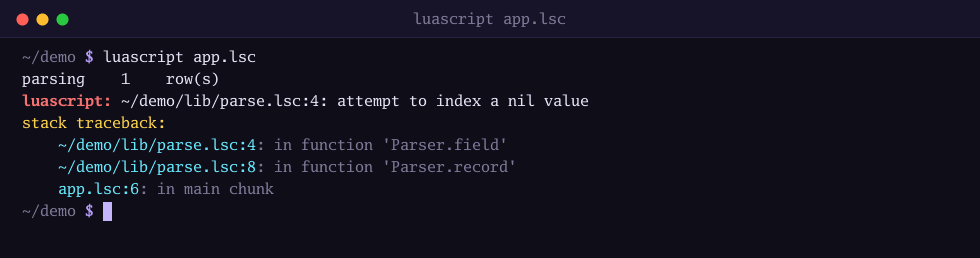
A few rules govern what you see:
- Positions point at the raise site.
pcall,try/catchandcoroutine.resumereport where the error was raised, not where it was caught. - Each chunk is named after the file it was loaded from, so a traceback crosses module boundaries. A module loaded by
requireis reported by the path it was found at. - Function names come from the binding:
local function f,function a.b:c,local f = function() endandM.run = function() endall name their function. A truly anonymous function shows asanon@<line>, the line it was defined on. - A stack that is only the main chunk prints no traceback, since the message prefix already says everything.
- Deep stacks are trimmed. The innermost 10 and outermost 11 frames are kept and the rest collapse into a single
... (skipping N levels)line, so a runaway recursion stays readable.
debug.traceback
require("debug") exposes the same stack walk to scripts. debug.traceback([msg [, level]]) returns a traceback string; level is how many frames to skip.
local debug = require("debug")

local function inner()
    print(debug.traceback("inside inner", 1))
end
local function outer()
    inner()
end
outer()
inside inner
stack traceback:
trace.lsc:4: in function 'inner'
trace.lsc:7: in function 'outer'
trace.lsc:9: in main chunkA non-string, non-nil first argument is returned unchanged, as in Lua 5.4. The module also provides debug.getinfo; sethook and gethook are accepted but are stubs. See examples/27_debug_module.lsc.
See also
- examples/55_try_catch.lsc, 32_defer.lsc, 59_to_be_closed.lsc, 52_attributes.lsc
- Coroutines for how errors cross
coroutine.resume - Architecture for how unwinding is implemented