Architecture
LuaScript is a clean-room implementation written to be read end to end. There is no LLVM, no JIT and no generated parser: source text goes through a straight pipeline of hand-written stages and ends up as bytecode for a stack-based virtual machine. This page walks through that pipeline and the runtime behind it. It is a condensed version of DESIGN.md, which is the document to read before changing the compiler or the VM.
Three constraints shape almost every decision:
- Readable end to end. Every stage is ordinary Go you can step through.
- Types are compile-time only. They are erased before bytecode generation. The VM has no notion of a type annotation, so the runtime is exactly the one you would have without the type system.
- Each stage is independently testable, and the AST is the only contract between them. The parser never produces instructions, and the VM never sees source text or types.
The pipeline
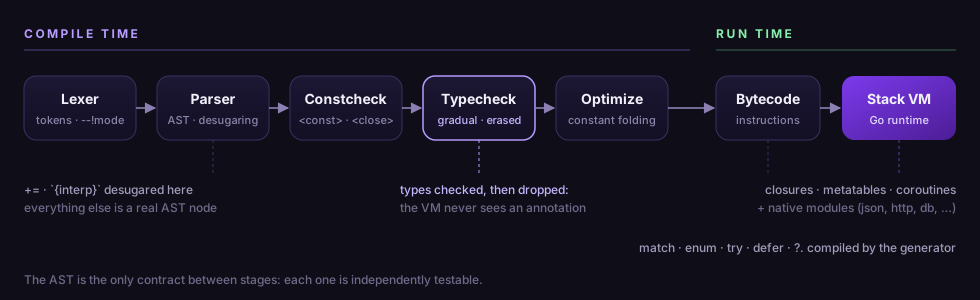
The whole pipeline is one function, CompileToInstructionsWith in internal/compiler/compiler.go. Reading it is the fastest way to understand stage ordering.
| Stage | Package | What it does |
|---|---|---|
| Lex | compiler/lexer/ | Lua 5.4 tokens, long-bracket strings and comments, backtick strings. Reads the mode directive (--!strict, --!nonstrict, --!nocheck) from line 1 and stamps a column on every token for error messages. |
| Parse | compiler/parser/ | Recursive descent for statements, Pratt parsing for expressions. Parses Lua 5.4 and Luau type syntax into an AST. |
| Const check | compiler/constcheck/ | Rejects assignment to <const> and <close> locals. Always runs. |
| Type check | compiler/typecheck/ | The gradual type system. Skipped under --!nocheck; all type information is discarded after this stage. |
| Fold | compiler/optimize/ | Constant folding on the AST, limited to a subset that is safe under Lua 5.4 semantics. |
| Generate | compiler/bytecode/ | Lowers the AST to an instruction set: one InstructionSet per function prototype. |
| Execute | vm/ | Runs the instructions on a value stack. |
constcheck runs before, and independently of, the type checker on purpose. local x <const> is a scoping guarantee rather than a type-checking nicety, so --!nocheck must not be able to switch it off.
Parser errors use a construct-aware format, <construct>: <expected> got <found> at line N, column C, followed by an indented hint: line:
luascript: pipeline: the right side of '|>' must be a function or a call, got 3 at line 1, column 9.
       hint: write `value |> f`, `value |> f(extra)`, or `value |> obj:method(extra)`
Keywords
match, enum, defer, try, catch and throw are hard keywords. type, struct, continue, impl and interface are contextual: they are only recognized where the next token cannot extend them into an expression, so continue = 1 and type(x) still parse as ordinary Lua.
What is desugared, and where
A recurring question is whether a construct is "real" or sugar. Some features are rewritten by the parser and never reach later stages; others have their own AST node and are lowered by the bytecode generator, sometimes with dedicated opcodes.
| Construct | Representation | Where it is lowered |
|---|---|---|
Compound assignment (+=, |=, ...) | none | Parser desugar to a plain assignment |
| Backtick string interpolation | none | Parser desugar to .. |
Pipeline x |> f(y) | none | Parser desugar to f(x, y) |
match | real AST node | Bytecode generator |
enum | real AST node | Bytecode generator, calling the __enum_freeze runtime helper |
struct | real AST node | Bytecode generator, calling __struct_define |
continue | real AST node | Jump to the loop's continue anchor |
| If-expressions | real AST node | Jump chain; folded when the condition is a literal |
| Default parameters | part of the parameter | Function prologue: if x == nil then x = default end |
| Destructuring and table spread | real AST nodes | Bytecode generator, calling __rest_array, __rest_record, __tbl_spread |
?., ?[ ], ?:, ?? | flags on index and call nodes | JumpIfNil guards |
defer | real AST node | Defer opcode; a closure list on the call frame |
try / catch / throw | real AST nodes | Try, EndTry, Throw opcodes |
local x <close> | attribute on a local | MarkTBC, CloseTBC opcodes |
Type assertions (x :: T) | real AST node | Erased: a runtime no-op |
The runtime helpers (__enum_freeze, __struct_define, __tbl_spread and friends) are Go functions installed as globals by small native packages (enumrt, structrt, tablert). They exist so that both the CLI and bundled executables get them through the same registrar list.
The type system
The checker in compiler/typecheck/ is gradual in the Luau sense: annotations are optional, an unannotated slot is any, and any flows into and out of every typed slot. An unannotated table literal is any so dynamic Lua patterns keep working, but a literal that meets a known type (an annotation, a typed parameter, a declared return) is checked field by field against it (table_literal.go).
- Signatures are hand-written. Globals and auto-global libraries are declared in
stdlib_types.go, which is whymath.sqrt(true)is a compile error. Theos,ioandutf8globals reuse theirnative_types.godeclarations, because at run time they are the same tablesrequirereturns. Native modules are declared innative_types.go, sorequire("json")with a literal name resolves to that module's type. - Generics (
generics.go) are instantiated on application, with best-effort inference at call sites. Inside a generic body a type variable is opaque but gradual, so parametric code never produces spurious errors. - Refinement (
refine.go) narrows types through type guards, nil checks, truthiness,assert, early exits, and short-circuit operators. Only simple identifiers are refined, not field paths. - Strictness comes from the line-1 directive.
--!strictturns implicit-anyparameters into errors;--!nocheckskips the stage entirely.
Because the declarations are hand-written, a test (TestNativeTypesMatchRuntime) compares the native-module declarations against a live VM: a signature that drifts from the implementation would reject correct scripts. Once checking succeeds, the AST is passed on unchanged and the types are simply never consulted again. See Types and Strict mode for the user-facing side.
Bytecode and the instruction set
The generator emits a flat list of instructions per function prototype. Each instruction has an opcode, a source line, and typed operand fields. There are 67 opcodes, declared in bytecode/instruction.go:
| Group | Opcodes |
|---|---|
| Loads | loadnil loadtrue loadfalse loadint loadfloat loadstring loadvararg closure |
| Variables | getlocal setlocal getupvalue setupvalue getglobal setglobal |
| Tables | newtable gettable settable getfield setfield self setlist |
| Arithmetic and bitwise | add sub mul div floordiv mod pow neg band bor bxor shl shr bnot |
| Strings and comparison | concat len eq noteq lt le gt ge not |
| Control flow | jump jumpiffalse jumpiftrue jumpiffalsekeep jumpiftruekeep jumpifnil |
| Calls and loops | call return markargs forprep forloop tforcall tforloop leave |
| Stack | pop dup |
| Scope and errors | defer closeupvalues try endtry throw marktbc closetbc |
luascript -dis prints the bytecode for a file instead of running it:
local function add(a: number, b: number): number
    return a + b
end

print(add(2, 3))
luascript -dis add.lscProgramStart ProgramStart (0+ params, 0 locals, 0 upvalues, 10 instructions)
0 [src 1] closure 0
1 [src 1] setlocal 0
2 [src 5] getglobal "print"
3 [src 5] markargs
4 [src 5] getlocal 0
5 [src 5] loadint 2
6 [src 5] loadint 3
7 [src 5] call 2 -1
8 [src 5] call -1 0
9 [src 5] leave
Function add (2 params, 2 locals, 0 upvalues, 5 instructions)
0 [src 2] getlocal 0
1 [src 2] getlocal 1
2 [src 2] add
3 [src 2] return 1
4 [src 1] leave
Function add (2 params, 2 locals, 0 upvalues, 5 instructions)
0 [src 2] getlocal 0
1 [src 2] getlocal 1
2 [src 2] add
3 [src 2] return 1
4 [src 1] leave A few things to notice:
- The types are gone.
a: numberand: numberproduce no instructions at all. - Nested functions are listed twice: indented under their parent, and again at the top level.
markargshandles multiple returns.add(2, 3)is the last argument toprint, so it may return any number of values. The generator emitsmarkargsto record the stack height, callsaddwith-1results ("all of them"), and callsprintwith-1arguments so the VM recovers the count from the mark. Fixed-arity calls skip this and pay nothing.- The main chunk shows
0 locals. The generator leaves the local count blank; the VM fills it in with a one-time scan of each prototype the first time it runs (local_table.go).
Constant folding happens before this point, so a literal expression compiles to a single load:
local SECONDS <const> = 60 * 60 * 24
print(SECONDS)
ProgramStart ProgramStart (0+ params, 0 locals, 0 upvalues, 6 instructions)
0 [src 1] loadint 86400
1 [src 1] setlocal 0
2 [src 2] getglobal "print"
3 [src 2] getlocal 0
4 [src 2] call 1 0
5 [src 2] leave The VM
The VM in internal/vm/ is a stack machine. A VM holds one value stack, a slice of call frames, the globals table, and the list of open upvalues.
Values
A Value is a Go any. Only a fixed set of Go types are runtime values: nil, bool, int64, float64, string, *Table, *Closure, *GoFunc, plus coroutines. Integers and floats are distinct Go types, which is how Lua 5.4's integer subtype is preserved. Native code converts at the boundary using helpers such as IntArg, StringArg and TableArg.
A Table keeps an array part and a hash part, plus a metatable pointer. Metamethods (__index, __newindex, arithmetic, comparison, __call, __tostring, __close, ...) are looked up on the slow path only: add, sub, mul, lt and le have inline fast paths for int-int and float-float operands.
Call frames, closures and upvalues
Each call pushes a CallFrame recording the closure, instruction pointer, stack base, expected result count and varargs. The frame also owns three lists that drive cleanup: deferred closures, live <close> values, and open try handlers. Frames are recycled from a small pool.
A Closure is a prototype plus a slice of upvalues. While the captured local is still on the stack, an upvalue points into the stack slot; when the scope ends, closeupvalues copies the value into the upvalue itself, so the closure keeps working after its creator returns. Every loop exit, including break and continue, re-emits closeupvalues so each iteration gets fresh captures.
Coroutines
Each coroutine runs its body on its own goroutine, and hands control back and forth with the resuming code over unbuffered channels. On resume, the VM saves the active stack, frames and open upvalues into the current thread and loads the coroutine's; on yield it swaps back. Only one side ever runs at a time, so this is cooperative multitasking, not parallelism. The VM has no locks, and Lua code only ever runs one call at a time. See Coroutines and Concurrency.
Errors and unwinding
A raised error is a Go panic. The call frames are VM state that nothing touches on the way out, so when the error is finally recovered, the Lua call stack that produced it is still intact. Exactly four places recover an error, and each records the raise position before discarding anything:
| Boundary | Catches for |
|---|---|
safeCall | pcall, xpcall, and Go code calling back into the VM |
dispatchToHandler | a try region |
Coroutine.goroutineBody | a coroutine dying, reported through resume |
recoverToError | an error reaching the host uncaught |
When a boundary handles an error, it runs the <close> values and defers of every abandoned frame, closes their upvalues, and truncates the stack back to where the protected call started.
try / catch
try is a protected region in the enclosing frame, not a pcall around a hidden closure. The try opcode pushes a handler onto the current frame, endtry pops it on every normal exit (including break and continue out of the body), and throw raises the value on top of the stack. Because handlers live on the frame, a return from inside a try needs no bookkeeping, and a coroutine's handlers travel with its frames.
The recovering loop is only entered for prototypes that contain a try, so every other call pays a single predictable branch. goto across a try boundary is rejected at compile time rather than miscompiled.
Tracebacks
Chunk names are stamped when a chunk is loaded, not when it is compiled, so the same cached bytecode can be loaded from two paths and still report the right file. Function names come from the binding (local function f, function a.b:c, M.run = function() end); a truly anonymous function reports as anon@<line>. Long tracebacks keep the innermost 10 and outermost 11 frames. See Errors.
Native modules
Native modules are Go packages under internal/native/ that expose a Register...Preload(v *vm.VM) function. It calls vm.RegisterPreload, which puts a loader into package.preload; require finds it there before searching the filesystem.
The single list of shipped modules is nativeRegistrars in cmd/luascript/natives.go. Both the CLI and bundled executables walk it, so adding a module is one line there. The last entry, promoteStandardGlobals, binds os, io and utf8 as globals, because the VM package cannot import the native packages that implement them.
Every native module is described in three places that must agree: the Go implementation, its type declaration in typecheck/native_types.go, and its documentation entry in internal/docs/. Tests compare the type declarations and the documentation against a live VM. See Native modules and Contributing.
Bytecode serialization and the compile cache
bytecode/serialize.go writes a compiled chunk, including its nested prototypes, to a binary format with the magic header LSCB. The header records the format version and the opcode count, so renumbering opcodes invalidates old chunks automatically.
The compile cache (compiler/bccache/) uses this format to skip compilation for files that have not changed. Running a file, require and loadfile consult it; the REPL, load() strings, -dis and bundled executables do not. Entries are keyed by a SHA-256 of the source, the interpreter version, the format version, the opcode count and the interpreter binary, and are only written after a fully successful compile. Any decoding failure falls back to a fresh compile. LUASCRIPT_NOCACHE=1 disables the cache and LUASCRIPT_CACHE_DIR relocates it. See Modules.
Bundled executables
luascript build -o app.exe script.lsc copies the interpreter binary and appends the script source, the version, and a magic trailer (LUASCRIPT01). On startup, before parsing flags, the interpreter checks its own tail. If the trailer is present it runs the embedded script with all native modules registered, exactly as the CLI would. The payload is source, not bytecode, and the output targets the host platform only. See CLI.
Documentation as data
internal/docs/ holds one curated entry per global, library function, module member and object method, grouped into topics, plus a renderer. It imports neither the VM nor the compiler, so every consumer can share it:
luascript docrenders man pages and searches them with-k.- The REPL's
doc <topic>command prints the same pages. - The language server derives all completion and hover information from it.
luascript doc -audit loads every module into a real VM and reports members that are undocumented or documented but missing.
Repository layout
.
├── cmd/luascript/     CLI, subcommands, bundler, natives.go
├── internal/
│   ├── compiler/      lexer, token, parser, ast, constcheck, typecheck,
│   │                  optimize, bytecode, bccache, analyze, debug
│   ├── vm/            stack VM, coroutines, core stdlib
│   ├── native/
│   │   ├── stdlib/    db, os, http, json, std, queue, log, io, ...
│   │   └── datascience/  ndarray, dataframe, stats, linalg, ml, plot, ...
│   ├── plugin/        run-time Go package loading (cgo, non-Windows)
│   ├── docs/          stdlib reference data + man-page renderer
│   ├── lsp/           language server
│   ├── formatter/     `luascript fmt`
│   ├── repl/          interactive REPL
│   ├── testrunner/    `luascript test`
│   ├── pkgmanager/    `luascript pkg`: manifest, lockfile, fetch
│   ├── bonsai/        ASCII bonsai side mode
│   ├── gctune/        GC tuning helpers
│   └── version/       version string
├── client/            VS Code extension (TypeScript)
├── examples/          runnable .lsc programs that double as tutorials
├── scripts/           build-pgo.sh, benchmark.rb
└── website/           this documentation site
Tests live next to the code. The bytecode tests assert exact opcode sequences for representative snippets, so any codegen change shows up as a test diff. The lexer and parser also have fuzz targets. See Contributing for how to run them.