Enums & tagged unions
enum comes in two forms. A bare enum is a frozen table of integer constants. Give any variant a payload and the whole enum becomes a tagged union (a sum type) with constructors, singletons, and exhaustive match.
Bare enums
enum Color
    RED,
    GREEN,
    BLUE,
end

print(Color.RED, Color.GREEN, Color.BLUE)   -- 1	2	3
Variants are bare identifiers separated by commas (a trailing comma is fine, and the whole thing can sit on one line: enum Color RED, GREEN, BLUE end). Values are integers, assigned from 1 in source order. There is no syntax for explicit values.
Frozen at run time
The enum table is read-only. Writing an existing variant, adding a new key, or swapping the metatable all fail:
enum Color RED, GREEN, BLUE end

print(pcall(function() Color.RED = 99 end))
print(pcall(function() Color.PURPLE = 4 end))
print(pcall(function() setmetatable(Color, {}) end))
print(getmetatable(Color))
false enum.lsc:3: attempt to modify enum 'Color'
false enum.lsc:4: attempt to modify enum 'Color'
false enum.lsc:5: cannot change a protected metatable
enumThe visible table is a proxy (that is how every write, not just writes to missing keys, hits __newindex), so pairs(Color) yields nothing. Iterate over a list of names instead, or pair the enum with a dispatch table:
enum Status OK, NOT_FOUND, SERVER_ERROR end

local handlers = {
    [Status.OK]           = function() return "everything is fine" end,
    [Status.NOT_FOUND]    = function() return "couldn't find it" end,
    [Status.SERVER_ERROR] = function() return "the server is on fire" end,
}
print(handlers[Status.NOT_FOUND]())   -- couldn't find it
Typed as a literal union
The enum name is also a type, and it denotes exactly the values the runtime can produce: Color is the literal union 1 | 2 | 3, and each member is a singleton (Color.RED has type 1).
enum Color RED, GREEN, BLUE end

local function name_of(c: Color): string
    if c == Color.RED then return "red"
    elseif c == Color.GREEN then return "green"
    end
    return "blue"
end

print(name_of(Color.GREEN))   -- fine
print(name_of(2))             -- fine: 2 really is a Color
print(name_of(99))
print(Color.MISSING)
luascript: Type "99" could not be converted into "Color" at line 12
type "{ RED: 1, GREEN: 2, BLUE: 3 }" has no field "MISSING" at line 13Because the domain is finite, comparing against a member narrows the union inside a branch, and a match over a Color is checked for exhaustiveness.
Tagged enums
As soon as one variant declares a payload, the enum becomes a tagged union:
enum Shape
    Circle(number),
    Rect(number, number),
    Unit,
end- A payload variant such as
Circle(number)becomes a constructor function. - A nullary variant such as
Unitbecomes a singleton value.
enum Shape
    Circle(number),
    Rect(number, number),
    Unit,
end

local c = Shape.Circle(5)
local r = Shape.Rect(3, 4)
local u = Shape.Unit

print(tostring(c), tostring(r), tostring(u))
print(typeof(c), c.__tag, c[1])
print(r[1], r[2])
print(u == Shape.Unit)
Shape.Circle(5) Shape.Rect(3, 4) Shape.Unit
Shape Circle 5
3 4
trueEvery value carries:
| Field | Value |
|---|---|
typeof(v) | The enum name ("Shape"), via the metatable's __type. |
v.__tag | The variant name ("Circle"). |
v[1], v[2], ... | The payload, positionally. |
Nullary variants are singletons, so == is a valid test for them. Payload values are fresh tables: Shape.Circle(5) == Shape.Circle(5) is false. The namespace is frozen just like a bare enum.
Checked construction
Payload types and arity are checked, and every constructor returns the enum type:
enum Shape
    Circle(number),
    Rect(number, number),
    Unit,
end

local a = Shape.Circle("five")
local b = Shape.Rect(1)
local n: number = Shape.Circle(1)
local x = Shape.Triangle(3)
luascript: Type "string" could not be converted into "number" at line 7
call passes 1 args, function expects at least 2 at line 8
Type "Shape" could not be converted into "number" at line 9
type "{ Circle: (number) -> Shape, Rect: (number, number) -> Shape, Unit: Shape }" has no field "Triangle" at line 10Consuming a tagged value
You can dispatch on __tag by hand:
enum Shape
    Circle(number),
    Rect(number, number),
    Unit,
end

local function area(s: Shape): number
    if s.__tag == "Circle" then
        return 3.14159 * s[1] * s[1]
    elseif s.__tag == "Rect" then
        return s[1] * s[2]
    end
    return 0
end

print(area(Shape.Rect(3, 4)))   -- 12
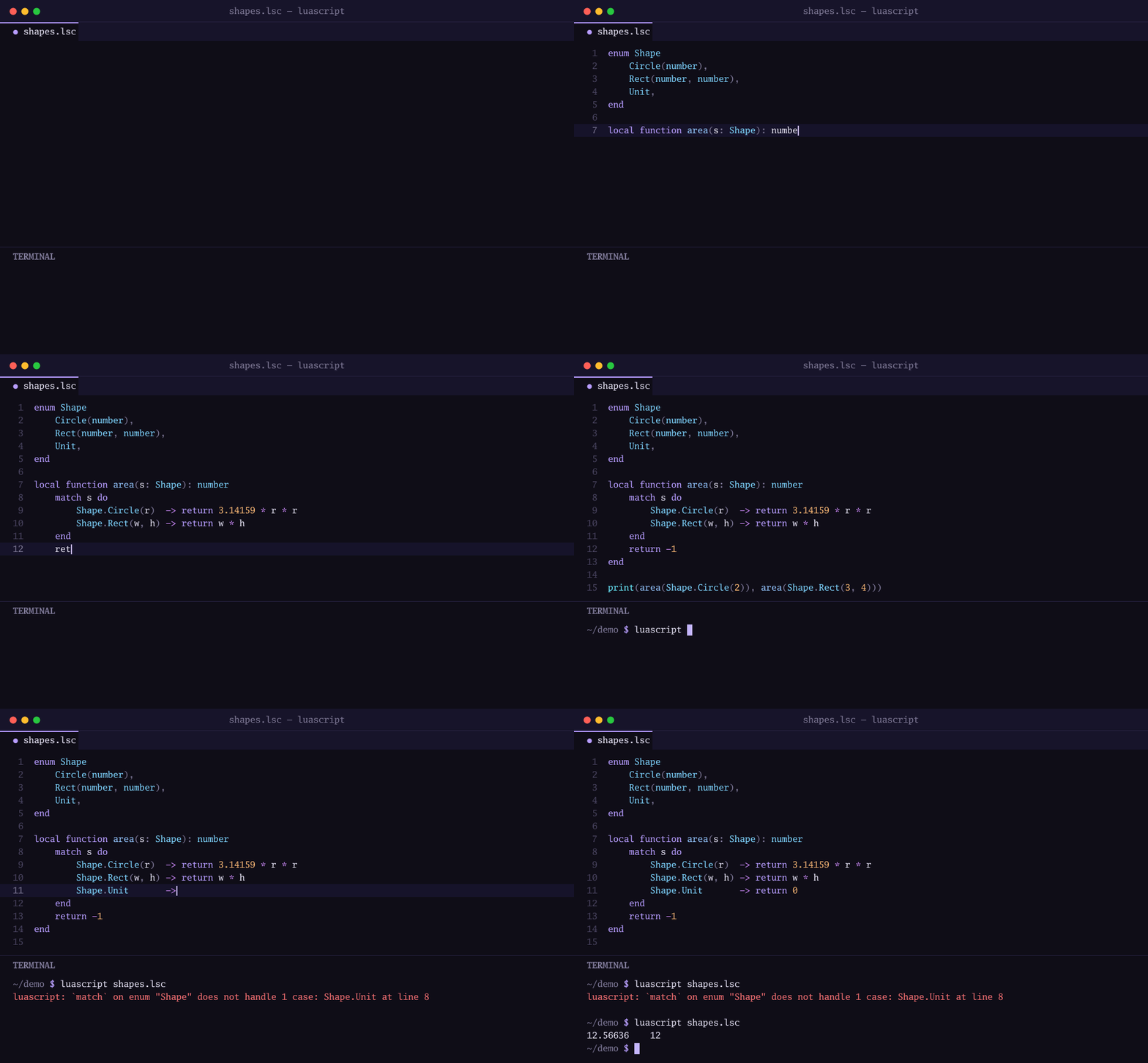
but match is the intended tool: it binds the payload by name and proves you handled every variant.
enum Shape
    Circle(number),
    Rect(number, number),
    Unit,
end

local function area(s: Shape): number
    match s do
        Shape.Circle(r)  -> return 3.14159 * r * r
        Shape.Rect(w, h) -> return w * h
        Shape.Unit       -> return 0
    end
    return -1
end

print(area(Shape.Circle(5)))   -- 78.53975
Result and Option
Tagged enums model fallible results without exceptions:
enum Result
    Ok(number),
    Err(string),
end

local function safe_div(a: number, b: number): Result
    if b == 0 then
        return Result.Err("division by zero")
    end
    return Result.Ok(a / b)
end

local function show(r: Result): string
    match r do
        Result.Ok(v)    -> return "ok: " .. v
        Result.Err(msg) -> return "error: " .. msg
    end
    return "?"
end

print(show(safe_div(10, 2)))   -- ok: 5.0
print(show(safe_div(1, 0)))    -- error: division by zero
An Option works the same way, with a nullary None:
enum Option
    Some(any),
    None,
end

local function find(xs: { string }, wanted: string): Option
    for i, x in ipairs(xs) do
        if x == wanted then
            return Option.Some(i)
        end
    end
    return Option.None
end

local function show(o: Option): string
    match o do
        Option.Some(i) -> return "found at " .. i
        Option.None    -> return "not found"
    end
    return "?"
end

local names = { "ada", "grace", "alan" }
print(show(find(names, "grace")))   -- found at 2
print(show(find(names, "linus")))   -- not found
Enums cannot take type parameters (enum Option<T> is a parse error), so a reusable Option uses any for its payload, or you declare one enum per payload type.
The runnable tours are examples/29_enums.lsc and examples/43_tagged_enums.lsc.